NASA's Bennu Sample Reveals a Hidden Chemical Patchwork
A PNAS study using nanoscale spectroscopy reveals Bennu's chemistry is far from uniform—with distinct regions shaped by varied water alteration, yet delicate organic molecules survive intact.
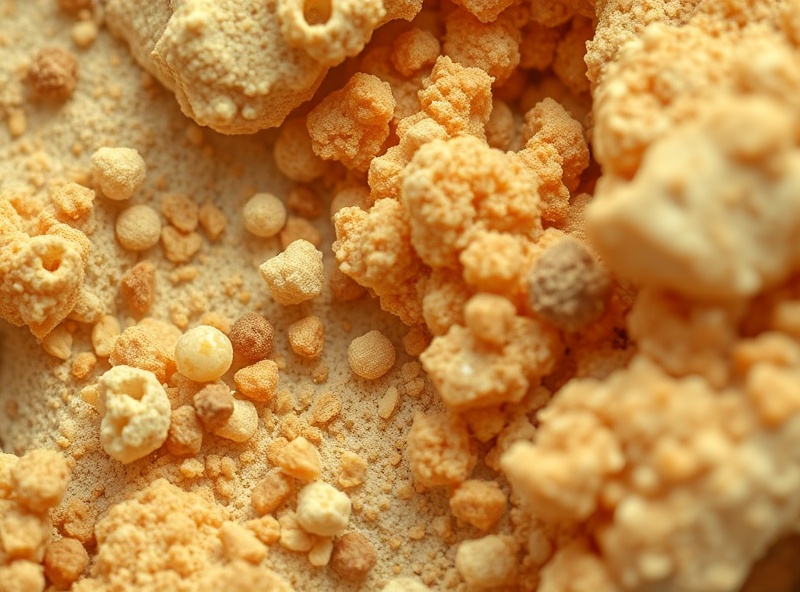
A groundbreaking study published March 31, 2026 in PNAS led by Mehmet Yesiltas reveals that asteroid Bennu's chemistry is far more complex and heterogeneous than previously thought. Using cutting-edge nanoscale infrared and Raman spectroscopy, researchers examined sample OREX-800066-3 and discovered that Bennu's organic compounds and minerals cluster into three distinct region types, each with its own chemical signature shaped by different histories of water alteration.
A Mosaic of Chemistry at the Nanoscale
The Yesiltas team used infrared spectroscopy and Raman spectroscopy—techniques sensitive to molecular vibrations and chemical bonds—to map the composition of Bennu sample OREX-800066-3 at unprecedented spatial resolution. Rather than finding a uniform composition, they discovered a chemical patchwork: three distinct region types coexisting within the same sample.
The three regions are: aliphatic organic-rich zones, carbonate-rich zones, and nitrogen-organic-rich zones. Each region tells a different story about Bennu's aqueous alteration history. Some zones show evidence of extensive water alteration, while others appear to have experienced minimal interaction with liquid water. This spatial variation suggests that Bennu's parent body—or Bennu itself—experienced nonuniform water activity, with some microscopic domains staying relatively "dry" while others were thoroughly processed by aqueous fluids.
Water Altered Bennu Unevenly—And That's the Key
What makes this discovery particularly significant is what it reveals about the early solar system environment on and around Bennu's parent body. If water had been uniformly distributed and actively circulating through the asteroid, we would expect a more homogeneous composition. Instead, the patchwork pattern indicates that water alteration was patchy, localized, and dependent on the specific mineralogy and structure of individual microscopic domains.
This heterogeneity is important for understanding planetary aqueous chemistry. It suggests that even within small bodies like Bennu's parent, water didn't simply percolate uniformly through the rock. Instead, alteration was controlled by microscale permeability, mineral composition, and the pathways water could access. Some organic-rich domains remained protected from water, while nearby regions underwent complete aqueous transformation.
Delicate Organics Survive Despite Water Alteration
Perhaps most remarkably, despite this complex water alteration history, delicate organic molecules—including amino acids and other prebiotic compounds—survived intact in the Bennu samples. This finding adds an important clue to a long-standing question in astrobiology: how do life's chemical building blocks survive processing in space?
The answer appears to lie in heterogeneity itself. The organic-rich zones, protected from severe aqueous alteration, preserved fragile molecules that would have been destroyed by prolonged exposure to warm, reactive water. At the same time, the carbonate-rich and altered regions demonstrate that water circulation occurred, generating mineral diversity and chemical complexity. This dual-path scenario—some regions protected, others processed—may be the optimal recipe for preserving life's chemistry in space.
Implications for Life's Origins
The Yesiltas study suggests that asteroids like Bennu may be better archives of prebiotic chemistry than we previously appreciated. Rather than being uniform, dead rocks, they are geochemical mosaics where different processes occur in adjacent microdomains. Some areas preserve the delicate organic chemistry from the solar nebula, while others reveal aqueous alteration. Together, these contrasting regions paint a portrait of the early solar system's chemical diversity.
For understanding how life's ingredients reached early Earth, this heterogeneity matters profoundly. Asteroids and comets may have delivered not just individual chemical building blocks, but entire libraries of prebiotic chemistry—some of it pristine, some of it chemically processed, each population offering different clues to how life emerged. Bennu's samples continue to reveal that the cosmos is far more chemically intricate than simpler models suggest.