The Discoveries
What OSIRIS-REx found inside asteroid Bennu is rewriting our understanding of life's chemical origins. Below are the ten major discoveries that scientists are still analyzing.
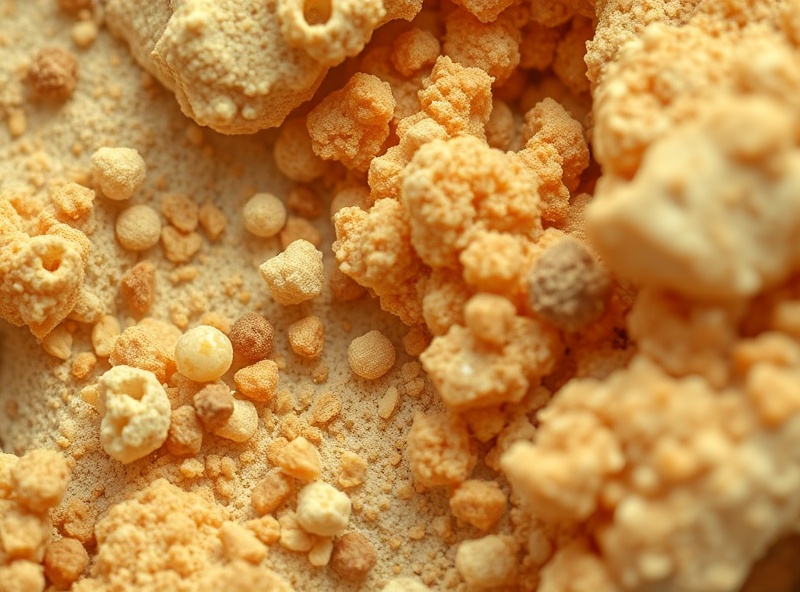
Organic Compounds & RNA Building Blocks
Bennu samples contain amino acids, nucleobases, and sugars—the exact building blocks needed for RNA and DNA, including the RNA sugar ribose and, for the first time in any extraterrestrial sample, glucose. A 2026 study (PNAS) further revealed that several of these amino acids formed in frozen space ice, not warm liquid water, dramatically expanding where in the cosmos life's chemistry can emerge.

Water & Evidence of Ancient Oceans
Minerals in the Bennu samples indicate Bennu's parent body was once an ocean world, rich with liquid water.

Nitrogen-Rich Organics
The Bennu samples contain abundant nitrogen-rich organic compounds, essential for life as we know it.

Evaporite Minerals & Ancient Brines
Salt minerals tell the story of ancient water evaporation, revealing chemical processes on the parent body.

Presolar Dust & Supernova Material
Bennu contains pristine dust from supernovae, material that predates our solar system by billions of years.

'Space Gum' & Complex Polymers
A polymer-like 'space gum', extremely rich in nitrogen and oxygen, found in the Bennu samples — never before seen in astromaterials. A February 2026 Nature Geoscience study further characterized this material as a potential chemical precursor that may have provided the scaffolding needed to trigger life on early Earth.

Magnesium-Sodium Phosphate & Ocean World Indicators
The presence of magnesium-sodium phosphate minerals in Bennu samples provides compelling chemical evidence that Bennu's parent body was once an ocean world, with conditions suitable for the emergence of complex chemistry.
OSIRIS-APEX: The Mission Continues
The success of OSIRIS-REx has led to OSIRIS-APEX, an extended mission launching toward asteroid Apophis in 2028. This will provide new insights into asteroid diversity and planetary defense strategies.
A Chemical Patchwork Inside Bennu
A March 2026 study in PNAS (Yesiltas et al.) used nanoscale infrared and Raman spectroscopy on Bennu sample OREX-800066-3 and found the asteroid's chemistry is not uniform — organic compounds and minerals cluster into three distinct region types (aliphatic organic-rich, carbonate-rich, and nitrogen-organic-rich), each shaped differently by past water activity. Despite this uneven water alteration, delicate organic molecules survived intact, showing life's chemical building blocks can persist even after complex geologic processing.
Why These Discoveries Matter
Origins of Life on Earth
The Bennu samples show that the building blocks of life—organic molecules and water—are abundant in space. This supports the hypothesis that Earth's life-bearing chemistry may have come, in part, from asteroids and comets delivered to the early Earth.
Solar System History
Bennu's pristine materials record the early solar system's chemistry, temperature, and water availability. Scientists can read these samples like a history book written 4.5 billion years ago.
The Search for Life Beyond Earth
Understanding what chemicals are available on asteroids helps us predict where life might emerge elsewhere in the universe—on moons like Europa and Enceladus, or on exoplanets.
Planetary Defense
By studying Bennu directly, we've learned how to characterize near-Earth asteroids and develop strategies to protect our planet. This knowledge is already being applied to future asteroid-deflection missions.